What Microsoft’s 2026 Report Means for AI Universe
Microsoft’s 2026 Responsible AI Transparency Report discusses how companies govern, test, and deploy agentic and generative AI safely.
The third edition of this report emphasizes that responsible AI is an ongoing discipline rather than a final destination. The framework adapts to rapidly changing autonomous capabilities.
The question is no longer only who provides the model. It is who provides the governed environment around the model: identity, permissions, tools, data, evaluation, runtime policy, telemetry, and intervention.
This is where AI Universe fits. It is Fortytwo’s answer to the need for a governed AI application foundation inside the customer’s own Azure environment.
The build-versus-buy question is too small
The conventional framing is build versus buy. In practice, there are three different paths, each with a different ownership model and a different answer to the governance problem.
The important question is not simply whether a team can connect a model to an application. Most teams can do that. The harder question is whether the resulting system can be identified, restricted, evaluated, observed, updated, and stopped when necessary.
Path One: Build it yourself
For organisations with strong Azure platform engineering teams, building a governed AI application environment from scratch is a valid path.
The advantages are genuine: full ownership of every component, an architecture designed for the organisation’s requirements, no dependency on a third-party platform vendor, and complete control over the upgrade cadence.
The cost is also genuine. The team must create and maintain the platform before product teams can use it.
Path Two: External SaaS
The second path is an external SaaS platform where the vendor operates the infrastructure and the customer connects applications to it.
The advantages are speed, lower initial engineering investment, and less infrastructure to operate.
The trade-off is that data, application logic, operational records, and platform controls may sit outside the customer’s Azure tenant.
Path Three: Governed foundation
A specialist provider deploys and maintains a governed AI application foundation inside the customer’s own Azure subscription.
The customer owns the Azure environment, repositories, identities, secrets, data, and operational records.
The provider maintains the shared platform layer, templates, security controls, and upgrade process.
Microsoft’s report changes what “governed” means
Microsoft’s 2026 Responsible AI Transparency Report describes a move away from model-only governance.
A model is only one component of a modern AI system. Agentic applications connect models to tools, data sources, services, memory, identities, and permissions. They can plan across several steps and take actions on behalf of a user or another application.
The system around the model increasingly determines the risk.
This creates a lifecycle problem. A point-in-time review cannot answer every question about a system whose tools, permissions, data, policies, and behaviour may change after deployment.
Microsoft’s report therefore focuses on continuous governance: identity, access controls, runtime policies, evaluation, red teaming, monitoring, human intervention, and the ability to activate, block, or revoke agents.
The report is about systems, not just models
Several details in Microsoft’s report show the scale of the change.
450+ Sensitive Use reviews were completed between July 2025 and June 2026. More than 30% were related to agentic AI.
Nearly 2,500 generative AI product and feature reviews show that governance is becoming a normal product-development activity.
3,000+ engineers took part in agentic threat-modelling workshops.
100+ AI Red Team operations were conducted during 2025.
ASSERT turns written agent policies into repeatable tests covering task adherence, tool selection, tool-call accuracy, and guardrails.
Agent identity and runtime policy provide a way to control which agents can access tools, resources, and actions under defined conditions.
These figures do not prove that every AI system is safe. The report is Microsoft’s own transparency account, not an independent certification. The figures do show how much operational work is required when responsible AI moves from a document into a running system.
What agentic systems add to the problem
A chatbot that produces a poor answer is one type of incident. An agent with an identity, tools, memory, permissions, and access to business systems creates a different type of exposure.
- The agent may select a tool that was not expected by the person who designed the workflow.
- A prompt injection may arrive through a document, web page, email, or retrieved record rather than through the user’s prompt.
- A permission that was safe for one step may become dangerous when combined with another tool.
- Memory can cause information or instructions from an earlier interaction to influence a later action.
- A chain of individually permitted actions can still produce an unacceptable final result.
- A system may continue acting after the original user has stopped watching it.
That is why Microsoft’s report discusses end-to-end execution, tool selection, tool-call accuracy, prompt injection defences, scoped permissions, secure execution, monitoring, and human intervention.
The more autonomy an application receives, the smaller and more observable its trust boundary should become.
How AI Universe answers the report
AI Universe is Fortytwo’s implementation of the third path from the build-or-buy discussion: a governed AI application foundation deployed inside the customer’s Azure subscription.
The connection to Microsoft’s report is architectural. Microsoft describes the controls that responsible agentic systems need. AI Universe provides a platform shape in which those controls can be assembled, operated, and assigned to application teams.
Identity
Each application can have its own identity and credentials instead of sharing one broad platform identity.
Gateway control
AI traffic can pass through a governed Azure API Management layer where access, usage, policy, and model routing can be managed centrally.
Application boundaries
Application environments can have separate repositories, secrets, data context, logs, costs, and revocation paths.
Secure delivery
Security-gated CI/CD and infrastructure as code make the deployment path part of the governance model.
Observability
Teams need evidence of deployments, model calls, tool activity, policy events, failures, usage, and cost.
Customer control
The Azure subscription, data, keys, repositories, identities, and operational records remain in the customer environment.
The choice is about ownership and operating responsibility
Choosing the right path depends on the organisation’s resources, data requirements, and time-to-value expectations.
Choose build when the platform itself is strategic
If the organisation has the people, funding, and operational maturity to own the complete foundation, building internally can be the right choice.
Choose SaaS when speed matters more than tenant control
An external platform may be suitable for low-risk use cases where the provider-hosted environment and data path meet the organisation’s requirements.
Choose a governed foundation when both control and speed matter
For regulated or security-sensitive workloads, a foundation deployed in the customer’s Azure tenant can preserve ownership while avoiding a multi-month platform build.
Shared governance, separate applications
The most useful AI platform pattern is not one giant shared environment. It is a governed core with separate application environments around it.
The shared layer can provide the policy baseline, model gateway, templates, deployment standards, and platform operations. Each application should still have its own identity, secrets, data context, deployment path, logs, cost records, and revocation boundary.
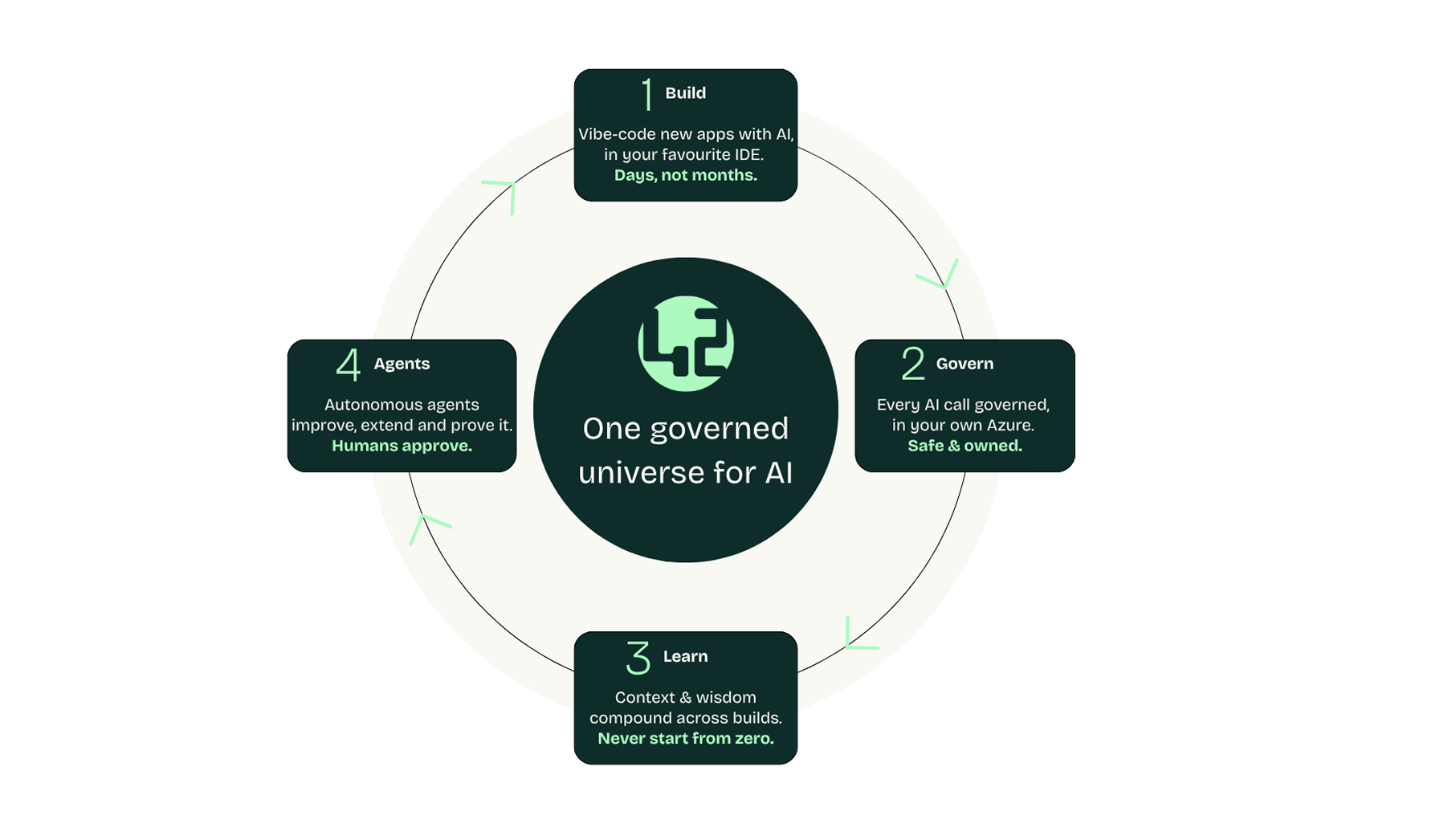
This is the practical AI Universe idea: centralise the controls that should be consistent, while keeping application ownership and failure boundaries separate.
What to verify before adopting any foundation
“Runs in your tenant” is a useful starting point, but it is not a complete security argument. Before adopting a governed AI foundation, ask for evidence about the following:
- Which resources are shared and which are dedicated?
- Which identities can access the model gateway and tools?
- How are secrets created, rotated, and revoked?
- How are applications separated from one another?
- Which network paths are allowed?
- What telemetry records model calls, tool calls, policy decisions, and failures?
- How are updates tested and rolled out?
- What exactly happens when one application must be stopped?
- Which data is retained, where, and for how long?
- How are prompt injection and untrusted tool output handled?
A governed foundation is valuable only when its boundaries can be explained, tested, and operated.
Where this is going
AI governance is moving toward a split model: central governance and shared controls combined with smaller application-level trust boundaries.
Platform teams will operate the common policies, gateway, identity patterns, templates, and evidence collection. Product teams will own the applications, domain data, user experience, and business outcomes.
The organisations that move fastest will not be the ones that remove every control. They will be the ones that make the controls repeatable enough that teams can use them without rebuilding the foundation for every application.
The governed foundation
AI Universe is Fortytwo’s implementation of Path Three: a governed AI application foundation deployed inside the customer’s Azure subscription.
It is designed to help organisations move from scattered AI pilots to repeatable application delivery without building the entire platform foundation from zero.
Fortytwo maintains the shared platform layer and delivers improvements as controlled updates. Customer teams build the domain-specific applications while retaining ownership of the Azure environment, data, identities, secrets, and operational records.
Let’s talk about AI in your company
If you want to discuss AI governance, application boundaries, or how AI Universe could fit into your Azure environment, contact Fortytwo.