Microsoft Entra External ID: A practical guide for technology leaders
29.6.2026, 7 minutes read time
TL; DR: Microsoft Entra External ID is designed to address identity drift by bringing external identity into the Microsoft Entra platform. It provides a more consistent way to manage access for people outside the workforce, whether for business collaboration or customer identity and access management.
What is Microsoft Entra External ID?
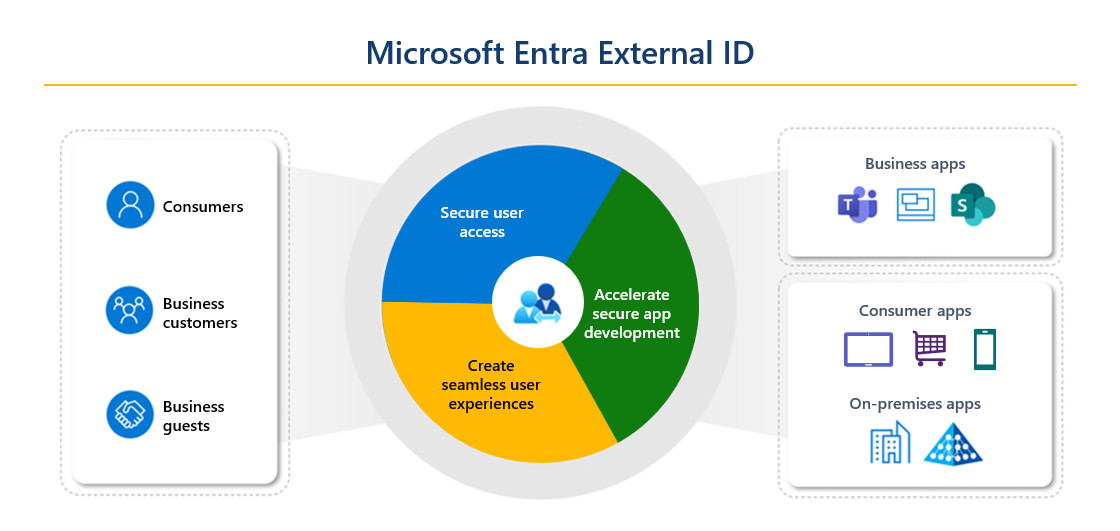
Microsoft Entra External ID is Microsoft’s identity platform for users outside the employee directory. It supports external collaboration with business guests and customer-facing identity scenarios for applications and digital services. Microsoft describes External ID as a solution for external identity scenarios, including B2B collaboration and customer identity and access management for apps.
In collaboration scenarios, External ID helps organizations give partners, suppliers, consultants, and other business guests access to the resources they need without turning them into regular employee accounts.
Users can authenticate with their existing identity, while the organization keeps control over how access is granted and managed.
In customer identity scenarios, External ID is used to secure applications for consumers, business customers, members, citizens, or other external user groups. This is done through an external tenant, which follows the Microsoft Entra tenant model but is configured for external-facing applications and user journeys. Microsoft’s documentation describes the external tenant as a distinct tenant for external scenarios, where customer credentials, profile data, and application registrations are managed separately from the workforce tenant.
The value is that external identity becomes part of a broader identity architecture instead of remaining scattered across applications, custom code, and disconnected platforms. For technology leaders, this is a question of how external identity should be governed, secured, integrated, and operated across the organization.
Why external identity management needs a clearer model
External identity is often built gradually when a team solves the immediate access problem, connects the application, and moves on. Over several years, this creates a patchwork of guest users, customer accounts, legacy identity providers, and shared access patterns.
It becomes difficult to manage when you need to answer basic questions concerning the security perimeter of the organization, as external users are all a part of it. Customer accounts, guest users, partner access, and supplier identities may not sit in the employee directory, but they still connect to applications, data, and business processes.
When external identity is poorly governed, the organization carries access risk without always seeing it clearly.
Customer experience is also affected. If identity is difficult to use, the service feels difficult to use. If identity is too loosely controlled, the organization increases security and compliance risk. A better external identity model must therefore balance usability, security, governance, and operational control. Microsoft Entra External ID gives organizations a platform for that model, but the architecture still needs to be designed deliberately.
Microsoft Entra External ID and Azure AD B2C migration
Azure AD B2C has been widely used for customer identity and access management, but Microsoft has moved its external identity roadmap toward Entra External ID. Azure AD B2C P1 and P2 are no longer available for purchase by new customers as of May 1, 2025, while existing customers can continue using the product. Microsoft states that Azure AD B2C will continue to be supported until at least May 2030.
Microsoft has published migration guidance for moving users, credentials, and applications from Azure AD B2C to Microsoft Entra External ID. This gives existing B2C customers time, but it should not be interpreted as a reason to wait.
Many Azure AD B2C environments contain business logic that has been built into custom policies, redirect patterns, and application-specific authentication behavior. These elements need to be reviewed before the organization can decide what should move to External ID, what should be redesigned, and what should be handled elsewhere in the architecture.
A migration from Azure AD B2C to External ID is therefore not always a direct platform replacement. It is often an opportunity to simplify the identity model, remove outdated patterns, standardize user journeys, and align customer identity with the rest of the Microsoft Entra ecosystem.
What changes with Microsoft Entra External ID?
The main change is that external identity can be handled through a more coherent Microsoft Entra architecture. For customer identity, External ID separates external users from the workforce directory by using an external tenant. This gives organizations a cleaner boundary between employees and customers, while still using a Microsoft Entra-based model for application access and identity management.
For collaboration, External ID gives business guests a way to access shared resources with their own identity, while the organization manages how collaboration is allowed. Microsoft’s B2B collaboration documentation describes this model as a way for external partners to use their own credentials to access the applications and resources an organization chooses to share.
For security and governance, the shift is from application-specific identity decisions toward a platform-based approach. Authentication, access policies, user journeys, and lifecycle processes can be managed more consistently, while authorization remains something each application must still design carefully.
External ID helps establish who the user is and under which conditions they can sign in, but applications still need a clear model for what that user is allowed to do after authentication.
For operations, the responsibility shifts from maintaining custom authentication infrastructure to managing the identity service well. That means designing user journeys, connecting applications, monitoring behavior, handling changes, and making sure the identity model remains aligned with business and security requirements.
Talk to us about Entra External ID Services
We help assess your current environment and assist in
migrating from Azure AD B2C to Entra External ID in a controlled way, without breaking production.
When Microsoft Entra External ID should be a priority
External ID should be a priority when external access is growing faster than the organization’s ability to govern it. This is often visible in Microsoft 365 and Entra environments, where guest access has expanded through Teams, SharePoint, projects, suppliers, and partner collaboration.
If guest accounts are not reviewed, ownership is unclear, or access remains after the business relationship has ended, external identity is already creating risk.
The same applies to customer-facing applications. If authentication is handled through custom code, an aging CIAM platform, unmanaged OAuth implementations, or an Azure AD B2C setup with complex legacy policies, the organization should assess whether the current model is still fit for purpose.
The issue is not whether the login still works. The issue is whether it can be governed, secured, migrated, and operated over the coming years.
External ID should also be considered when customer experience is held back by identity. Friction can increase support demand and reduce adoption. A modern external identity platform can make these journeys more consistent, but only if the organization designs them around real user needs.
How to start with Microsoft Entra External ID
The first step is to understand the current external identity landscape. The next step is to define the target model. Some external users belong in B2B collaboration because they need access to internal resources as business guests. Others belong in a customer identity model because they use public-facing or customer-facing applications. Some scenarios may require a dedicated external tenant, while others may need stronger application-level authorization outside the identity platform.
From there, migration and implementation should be planned as a controlled program. External identity affects live users and production services, so changes need to be tested, staged, communicated, and monitored. This is particularly important for Azure AD B2C migration, where custom policies and application dependencies can make the move more complex than it first appears.
Microsoft Entra External ID gives you a modern foundation for external identity management. The organizations that gain the most value will be the ones that treat it as part of their long-term identity architecture, not as another application login project.
The practical starting point is simple: map who signs in from outside the organization, understand how those identities are managed today, and get ready to migrate to the next phase of digital business.
Get in touch
Make security work before it matters
Incidents do not wait for maturity models.
Security operations must work when pressure is highest.
Talk to Fortytwo about SecOps that gives you clarity, control, and confidence in the Microsoft ecosystem.